Blog
Watchmaking back in fashion?
28 July 2025
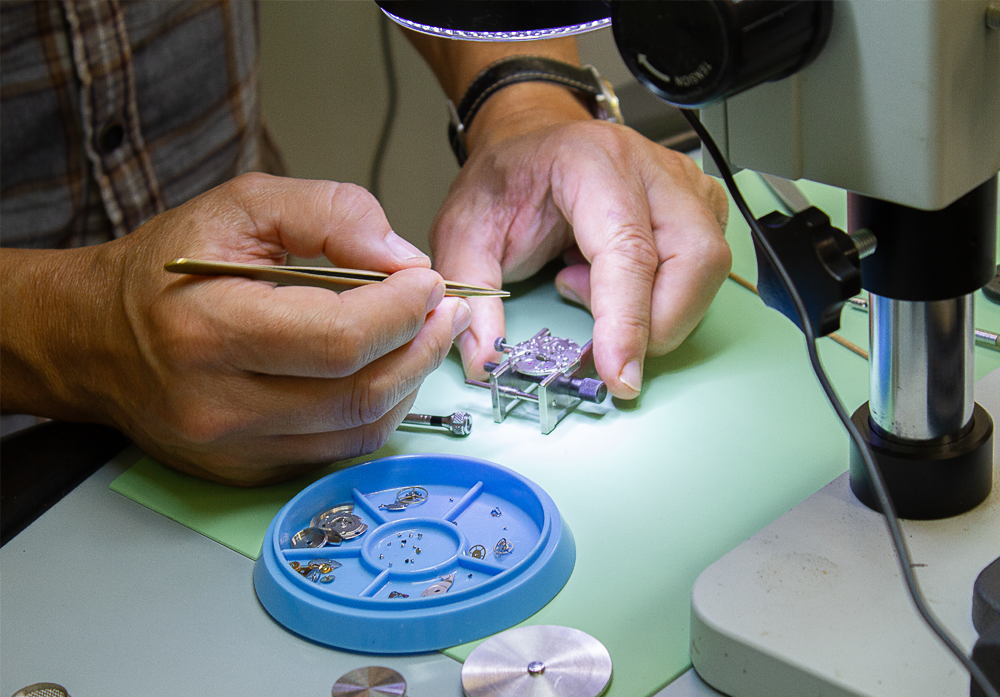
Right now, in workshops, studios and converted garden sheds across the UK, a growing number of men and women are quietly breathing new life into a craft that, by rights, bears little significance in today’s high tech world.
The likes of GPS satellites and atomic clocks mean that our smart watches and home devices can do a quite remarkable job of accurately telling us the time. In every logical sense they have stripped our need to create elaborate mechanical timepieces. However, it’s a curious quirk of human nature that not only do we continue to be fascinated by mechanical watches, but we pay upwards of six figure sums to collect them, and revere those who – like the great watchmakers of the 17th and 18th centuries before them – devote their lives to designing and developing ever more miniscule, mind-blowingly complicated movements. Makers such as the late George Daniels CBE and his protégé, Roger Smith, whose story was made into the 2015 box office hit The Watchmaker’s Apprentice.
As a result, it would appear that a glimmer of hope is on the horizon for the art of watchmaking, which has been classed as ‘critically endangered’ by Heritage Crafts – a national charity set up to celebrate, support and safeguard traditional craft skills – with clockmaking classed as ‘endangered’.
Could we be seeing a swathe of modern-day watchmakers emerge, keen to keep the age-old skills alive and support the horological trade and its associated crafts, such as enamelling and engraving? “We are certainly seeing a rise in demand for training,” says Alan Burtoft FBHI, who is President of the British Horological Institute (BHI).
“The BHI runs courses right across the board, from watchmaking taster days and build your own watch workshops to advanced level professional exams aimed at those who work in the industry and are following the BHI’s examination pathway. At every level, the interest in watchmaking as a hobby or a job is gaining momentum, but it is still an endangered craft. We need more people to consider it a career – to join the BHI and learn more about the fascinating world of horology and discover the heritage skills that could so easily be lost if a new generation doesn’t embrace them.”
Since the 1850s the BHI has forged a path, becoming one of the world’s leading training organisations and helping many thousands of talented craftsman become professional watch- and clockmakers. Today, from its country house headquarters close to Newark in Nottinghamshire, it proudly stands as a bastion of excellence in the trade, its team of friendly expert tutors presiding over a huge range of workshop courses.
“Go have a look at our website (www.bhi.co.uk), have a chat with us at one of our open days at Upton Hall, and see what we can offer to members [next open day, which is free to everyone, is Saturday 18 October 2025 at Upton Hall],” adds Alan, himself a watchmaker with more than 50 years’ experience in the industry. “The watch world is fast evolving; it’s championing craftsmanship and engineering, with watch micro brands such as Nixon and Stirling Timepieces gaining a huge following on social media.”
Indeed, proof that watchmaking now has a younger, edgier following was evident at the 2024 debut of British Watchmakers’ Day, organised by the Alliance of British Watch & Clock Makers. As the morning of the 2025 event dawned at Lindley Hall in Westminster, the organisers were unsure whether the success of their first event was an unprecedented one off. They needn’t have worried. “The queue started gathering from 5am,” says Alistair Audsley, Chief Executive of the Alliance, “and formed what quickly became a 600-strong ‘pavement party’”.
If we add that 1,300 watch enthusiasts packed the Lindley Hall over two sessions, and one of the Day’s stars – The Gimlet watch – presented as a collaboration by Fears and Studio Underd0g sold as fast as the sales could be processed by the card readers (at £1,000 a pop. And there were 200 on sale), you will appreciate that the British watch market is heating up.
So where does this leave anyone with a thirst to find out more (and good eyesight, as you can expect to spend a lot of your time searching for missing watch parts on the bench)? “In a very good place,” says Alan. “Join one of our watchmaking taster days and get a feel for the craft – you never know where it may lead.”
Train as a watchmaker and leave your mark on the world of timekeeping? It’s about time…
Give it a try
The BHI’s watchmaking taster days are run on selected dates year-round at Upton Hall near Newark in Nottinghamshire, just off the A1. Prices start at £260, see Short Courses page for details.
About the author
Helen Milbank is the Production Editor of The Horological Journal, the official publication of the British Horological Institute (BHI), and the oldest continually published technical journal in the world. It is posted for free to all members of the BHI – for more on how to become a member see here:
….and details of upcoming BHI training courses in clock and watchmaking for professionals, students and hobbyists, click the link below:
Latest Articles

30 September 2026
October 2026 Horological Journal
The covers of the October edition of the HJ feature an intriguing table clock co-signed by East and Fromanteel, although the origins of its engraved case are the subject of deeper research. It is thought to be the first English full grande sonnerie clock, and one of the earliest English clocks fitted with a minute hand. Also in this issue, David Poole […]
Find out more
28 August 2026
September 2026 Horological Journal
The covers of the September edition illustrate the watch with perhaps the earliest recorded written provenance. Dating from circa 1620 and predating the balance spring, the watch is signed Edmund Bull and is in remarkably original condition. Selected for the HJ to mark the closing down of the website of horologist and illustrator David Penney, read more here: Download […]
Find out more


